
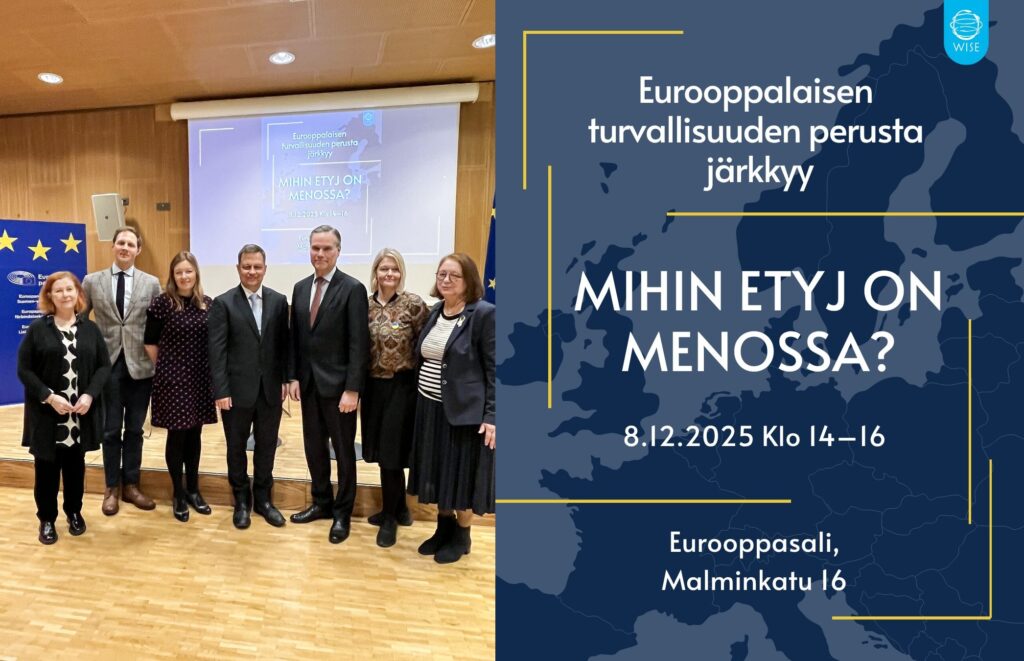
At the WISE security policy seminar on Where is the OSCE Heading? (Mihin ETYJ on menossa?), held on 8th of December 2025 at Eurooppasali in Helsinki, Bradley Reynolds examined the role of the OSCE in today’s shifting European security environment.
In his remarks, Reynolds asked what the OSCE can offer in a new era marked by geopolitical tension and institutional reform. Referring to recent discussions in Vienna, he noted growing calls to reshape the OSCE into a narrower platform for dialogue on arms control, border security, counterterrorism, and cooperation with Russia — potentially at the expense of human rights and environmental dimensions.
Reynolds contrasted this with Finland’s recent OSCE Chairpersonship, which placed strong emphasis on strengthening civil society participation. He argued that the OSCE’s unique added value, compared to the EU or NATO, lies precisely in its ability to provide space for citizen engagement in security policy. Democratic resilience, he stressed, depends on meaningful participation — a point also reflected in EU reports and Finland’s Civil Society Strategy 2023–2027.
Drawing on historical examples from the CSCE process and the work of STETE (founded in 1970 to mobilise citizen support for the European Security Conference), Reynolds highlighted the important role civil society played in shaping the Helsinki process. Rather than being merely inspired by intergovernmental negotiations, civic actors actively pressured states to engage in dialogue — a dynamic sometimes referred to as the “Spirit of Helsinki” or the “Helsinki Conscience.”
Reynolds concluded that if the OSCE is reformed in ways that narrow its comprehensive security approach, renewed civic engagement will once again be essential. Informed and active citizens, he argued, are a prerequisite for effective democratic foreign policy. Reviving the “Helsinki Conscience” is therefore not only a historical reference but a contemporary necessity for European security.